6 Min Read
You’ve probably already figured out that financing a custom home build is nothing like financing a purchase. The mortgage calculator doesn’t apply. The process is different.
It’s not complicated. It’s just different. Understanding it early keeps everything else from becoming harder than it needs to be.
This guide covers how custom home financing actually works — what loan types are available, how money moves from lender to builder, what lenders need before they’ll commit, and what to expect if you’re building in Western North Carolina specifically.
The loan you’ll most likely use
Before you start comparing lenders, download our Cost Guide to understand what custom home builds actually cost in Asheville.
A construction-to-permanent loan — most people just call it a construction-to-perm — is the most common way to finance a custom home build. It combines two things that used to require two separate loans into one.
Here’s how it works.
When you close on the loan, construction begins. During the build — which typically runs 12 to 18 months for a custom home in WNC — you make interest-only payments on the money that’s actually been drawn, not the full loan amount. In the early months when only foundation and framing costs have been released, your payments are small. They grow as the build progresses and more funds are drawn.
When construction is complete and your certificate of occupancy is issued, the loan converts automatically to a standard 30-year mortgage. One closing. One set of closing costs. The rate you locked at the start carries forward.
That’s the construction-to-perm. Clean, predictable, and the right tool for most custom home clients.
There’s also a two-close option — a standalone construction loan that you refinance into a permanent mortgage at the end. Some buyers choose this when they expect interest rates to improve before their build finishes, or when their financial picture is going to change significantly between now and move-in. It gives you more flexibility on the permanent mortgage side, but you’ll pay closing costs twice. Worth a conversation with your lender if your situation is anything other than straightforward.

What it actually costs to finance a build
Construction loans are more expensive than conventional mortgages. That’s just the reality, and it’s worth understanding why.
From a lender’s perspective, a construction loan carries more risk than a mortgage on an existing house. There’s no finished home to use as collateral yet. The lender is essentially betting that the home will be built as planned, on budget, and that you’ll be able to make payments once it converts. They price that risk into the rate.
Current construction loan rates in North Carolina run roughly 1 to 2 percentage points higher than conventional mortgage rates. On top of that, plan for inspection fees — lenders typically send an inspector to verify progress before releasing each draw, and those run $300 to $600 each with six to ten draws on a typical custom home build. Budget for that alongside your construction costs.
Most lenders want to see a complete down payment — typically 20% or more — along with detailed construction plans, a line-item budget, and a signed contract with your builder before they’ll fully commit. For the custom home builds we do in Asheville, which typically start at $1.25 million, lenders are generally looking at overall financial position and liquidity rather than running standard qualification checklists.
That documentation requirement matters more than people realize. We’ll come back to it.
How the money actually moves: the draw schedule
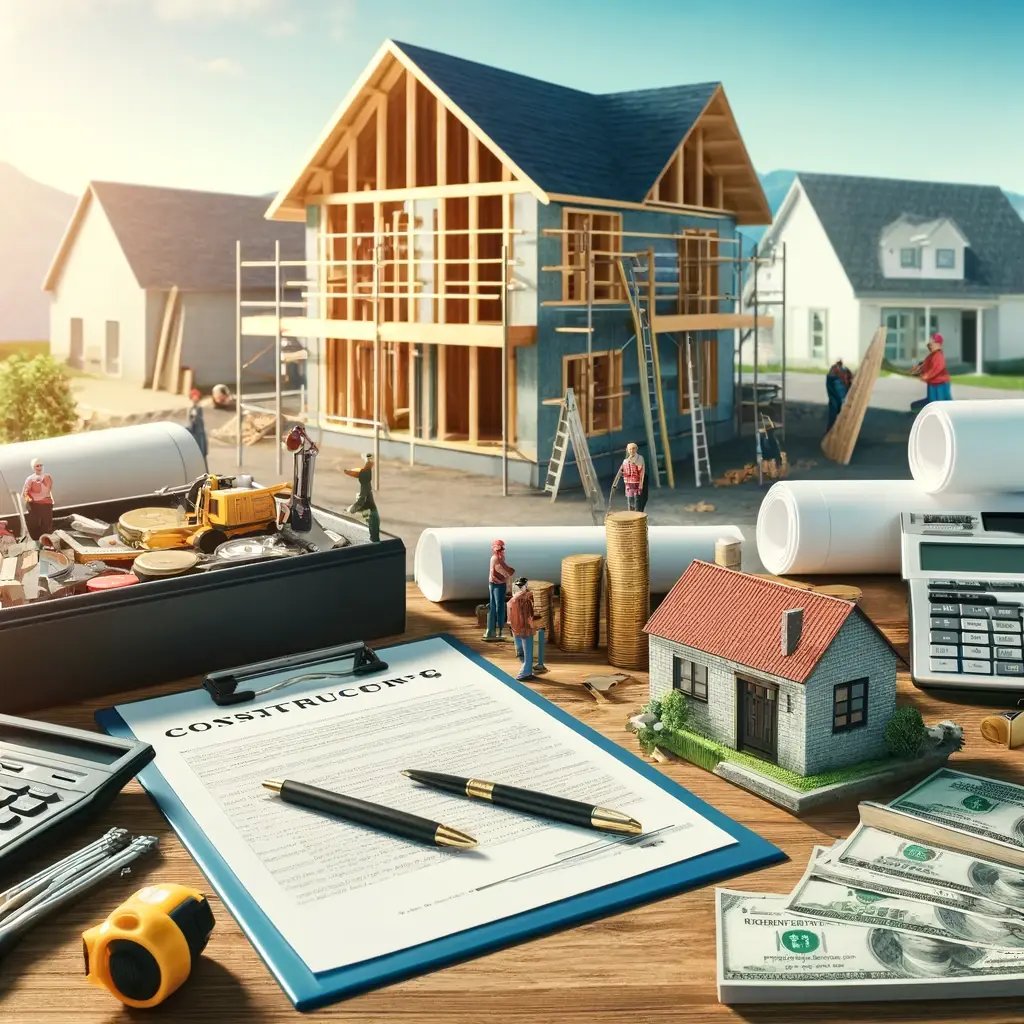
This is the part that confuses most first-time custom home clients. You don’t get a check for the full loan amount on day one. The money comes out in stages called draws, tied to construction progress.
A typical custom home build has six to ten draws. The first covers site work and foundation. The second covers framing. Then rough mechanical — plumbing, electrical, HVAC roughed in. Then drywall and interior work. Then final completion. Each phase has to be verified before the next draw is released.
Before each draw is released, the lender sends an inspector to verify that the work for that phase has been completed. The inspector confirms it. The lender releases funds. The builder gets paid. Construction continues.
This system protects everyone. The lender isn’t releasing money for work that hasn’t happened. The builder gets paid as work is completed. And you have a built-in checkpoint at every phase of the build.
The practical implication: the way most custom home builds work, you pay your builder directly when a draw milestone is hit — then you request reimbursement from your lender. That’s standard practice. Your lender’s inspection and release process runs on their timeline, not your builder’s. So, it’s worth understanding upfront how quickly your lender moves between an inspection request and a fund release, and factoring that into how you manage your cash flow during the build.
What lenders need before they’ll approve you
Here’s the thing about construction loan approval that trips people up: you can’t get fully approved until the pre-construction work is done.
Banks need a signed builder contract, a complete and detailed construction budget, and a finalized set of drawings before they will commit. Not rough numbers. Not preliminary sketches. The real thing.
This is actually good news if you understand it early. It means your pre-construction process — where you work with your builder to finalize the design, get the budget locked, and produce the documentation — is doing double duty. It’s producing what you need to build the house and what you need to borrow the money.
Go into your design process knowing that the output of that phase is your loan package. Our Pre-construction process makes your lender experience smoother.
How this works with a design-build firm in WNC
Just like the mountains of WNC, the Asheville custom home market has its own texture.
About 70% of the custom home clients we work with at Kaizen Homes pay cash. If you're in that group, learn more about what's included on our custom home service page. That’s not unusual for this market. The people building custom homes in Western North Carolina tend to have been planning this for a long time, and many have structured their finances accordingly.
For the clients who do finance, there’s something important to understand about how boutique design-build firms typically structure the relationship.
Our contract is with you, the client. Not with your bank.
When a draw milestone is reached, we invoice you directly. You pay that invoice. Then you go to your lender and request reimbursement. The bank’s inspection and release process is your workflow to manage, not ours. This is different from some larger production builders who coordinate draw requests directly with lenders.
What that means practically: if you’re financing, you need to understand your lender’s draw release timeline and plan your cash flow around it. It’s manageable — many of our clients navigate it smoothly — but it’s not something to discover mid-build.
The upside of this arrangement: our pre-construction process produces exactly what your lender needs. By the time we’ve completed pre-construction together, you have a signed contract, a detailed line-item budget, a complete set of drawings, and a site assessment. That’s your complete loan package, ready to go.
One thing every budget needs: a contingency
Whether you’re financing or paying cash, your construction budget needs a contingency fund. Typically 10 to 15% of total project cost.
Mountain building surprises people. Not because builders aren’t careful — because you genuinely cannot know everything about a mountain site until excavation begins. Rocky soil where the Geotech report suggested otherwise. A ledge that requires blasting. Drainage that behaves differently than the topo indicated. These things happen in WNC. They’re completely manageable when you’ve budgeted for them. They’re stressful when you haven’t.
We’ll cover contingency funds in depth in a separate guide — how to size yours based on your site, what typically gets spent, and how to think about it so it doesn’t just become a number on a spreadsheet.
What to look for in a construction lender
We don’t steer clients toward a specific lender. That’s intentional — your financing relationship is yours, and we don’t want any referral arrangement to influence a decision that should be entirely about what’s right for you.
What we can tell you is what we’ve seen work. Work with someone local.
Work with someone who has done custom home construction loans specifically. Not just new construction, not just conventional purchases — custom. These loans have longer timelines, more complex documentation requirements, and draw schedules that don’t always follow a tidy pattern. A lender who handles them routinely will navigate the process very differently than one treating it as an unusual transaction.
Ask three questions before you commit:
- How long does your draw inspection and release process typically take?
- How do you handle mid-build change orders that affect the loan amount?
- What happens if the build runs past the initial loan term?
The quality of those answers tells you a lot about what working with them will actually feel like.
Local lenders often have a real advantage here. They’ve processed projects in Western North Carolina. They understand what mountain site work costs. They’ve seen WNC mountain builds before and they know what’s normal. Their experience makes our team stronger.
When to start the financing conversation
Earlier than feels necessary.
Get pre-approved before you start designing. Pre-approval tells you your real borrowing capacity — not the number the mortgage calculator suggests, but the number a lender will actually put in writing after looking at your full financial picture. That number shapes every design decision you will make.
Clients who come to the design process with financing already figured out move faster, decide more confidently, and almost never have the painful experience of falling in love with a design they can’t afford to build.
If you’re paying cash, the principle is the same: know your real number before you start. Our Cost Guide breaks down what custom home builds in Asheville cost at different levels of finish and complexity — a good place to ground your expectations before the first design conversation.
We understand the ins and outs of the lending process. When you’re ready to talk about your project — financing sorted or not — a discovery call with our team is the right next step.